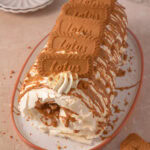
Biscoff Meringue Roulade
Light and fluffy meringue roll filled with Biscoff spread and whipped cream
Servings 8
Calories 402kcal
Ingredients
For the meringue
- 5 Egg whites
- 260 g Caster sugar
- 1 tsp Cornflour
- 1 tsp Lemon juice or white vinegar
For the filling
- 300 ml Double cream
- 1 tbsp Icing sugar
- 1 tsp Vanilla extract
- 80 g Biscoff spread warmed
For decoration
- 45 g Biscoff spread warmed
- 6 Biscoff biscuits
- 1 Biscoff biscuit crushed
Instructions
- Pre-heat your oven to 160C Fan/350F/Gas Mark 4, line a swiss roll tin or lipped baking tray with baking paper (grease it lightly to help it stick). The one I used was a Wilton tray that is 33.7 x 23.5 cm (13.25 x 9.25 inches)
- Add the egg whites to the bowl of your electric stand mixer, or you can put them in a mixing bowl and use a hand held electric mixer. Whisk them until they are foamy and reach soft peaks stage – when you can tip the bowl and they don’t move (this takes about 3 minutes in my mixer on speed 6)
- Keep the mixer running and add the caster sugar one spoonful at a time, then add the cornflour and lemon juice. Mix on a high speed for 3-4 minutes until thick and glossy, you want to be able to rub the meringue between your fingers and not be able to feel any sugar grains
- Spread the meringue out into the tin in an even layer, and bake for 10 minutes. Then, turn the oven down to 140C Fan/300F/Gas Mark 3 and bake for a further 15 minutes, or until risen and just starting to colour
- Before you take the roulade out of the oven, prepare a sheet of baking paper dusted with icing sugar that is bigger than the roulade
- Remove the roulade from the oven and tip it out onto the icing sugar covered baking paper, remove the tin and the baking paper it was baked with, then leave to cool
- Whip up the double cream with the icing sugar and vanilla extract until thick, an electric mixer is best for this
- Spread most of the double cream over the roulade (save 5-6 tbsp to decorate the top if you like)
- Warm the Biscoff spread for the filling by putting in the microwave for 10-20 seconds, and drizzle it over the whipped cream
- Roll up the roulade, don’t worry about neatness or cracks – it's normal. Place onto a serving plate, and drizzle with more warmed Biscoff spread, dollop or pipe the remaining whipped cream down the centre, then add the Biscoff biscuits
- Serve immediately, store any leftovers in the fridge and eat within 2 days
Video
Notes
- Make sure your eggs are at room temperature before you start baking.
- If you don't have any lemon juice, you can replace it with 1 tsp white vinegar, 1 tsp cider vinegar, or ½ tsp cream of tartar.
- If you're more of a Nutella fan, you'll like my Nutella Meringue Roulade.
- Make sure your mixing bowl is completely grease free before making your meringue, as grease will stop the egg whites from foaming. You can wipe your bowl down with lemon juice or white vinegar to ensure any traces of grease is removed.
- When separating your eggs make sure not to get any egg yolk in the egg whites, as this will also stop it from foaming.
- The biscuits will go soft after several hours in contact with the cream so add them later if you’re not serving straight away.
- Although I provide cup measurements, I highly recommend weighing your ingredients out using digital kitchen scales. It is the most accurate way to measure ingredients and will ensure the best results. Digital scales are very low cost and can be purchased for around £12 ($16.50).
- For teaspoon (tsp) and tablespoon (tbsp) measurements, please use measuring spoons and not the type of spoons you eat with. Again this will ensure accuracy and provide the best results.

Nutrition
Calories: 402kcal | Carbohydrates: 48g | Protein: 5g | Fat: 22g | Saturated Fat: 11g | Polyunsaturated Fat: 1g | Monounsaturated Fat: 4g | Cholesterol: 43mg | Sodium: 68mg | Potassium: 75mg | Fiber: 0.1g | Sugar: 42g | Vitamin A: 561IU | Vitamin C: 0.5mg | Calcium: 28mg | Iron: 0.3mg
