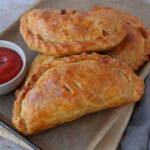
Cheese, Marmite & Potato Pasties
Crispy shortcrust pastry parcels with a cheese, potato, onion and marmite filling
Servings 6
Calories 610kcal
Ingredients
For the pastry
- 350 g Plain flour (also known as all purpose flour)
- A pinch of salt
- 170 g Butter or baking spread
- 2 Eggs large
- 1 Egg beaten, for glazing the pastry
For the filling
- ½ tbsp Vegetable oil
- ½ tbsp Butter
- 1 White onion diced
- 2 cloves Garlic finely chopped
- 2 tbsp Marmite
- 2 tbsp Water
- A pinch of salt
- 350 g Potatoes diced into small cubes
- 120 g Cheddar cheese grated
Instructions
- To make the pastry, weigh out the flour and butter into a mixing bowl, and add the salt. Rub the butter into the flour and salt using your finger tips until it resembles breadcrumbs. You can also do this in a food processor, or using a fork
- Add the eggs and mix it together until a dough forms, do not overly knead the dough. Wrap the pastry dough in cling film and chill it in the fridge for 30 minutes
- Meanwhile, make the filling. Warm up the oil and butter in a large frying pan on a low heat and add the onion and garlic. Cook for around 5 minutes until the onion has softened
- Add the diced potato and fry for around 15 minutes
- Add the Marmite, water and salt. Cook for 5 minutes so the potatoes can absorb plenty of the Marmite
- Take off the heat and leave to cool. Once cool, mix in the grated cheddar cheese
- Pre-heat your oven to 200C Fan/425F/Gas Mark 7. Roll out the pastry onto a mat or work surface dusted with flour to about 2mm thick. Use a 6" round cutter, an upside bowl or a small side plate to cut out rounds of pastry. You will need to re-roll the dough once or twice to get all 6 rounds
- Spoon the filling into the centre of the pastry circle, brush the edges with the beaten egg, then fold the dough over the filling and either roll the edges over with your fingers, or crimp the edges with a fork to seal them. Then cut two small slits in the top of each pasty with a sharp knife
- Move the pasties onto lined baking trays and brush them with beaten egg. Bake them for 25 minutes or until the pastry is golden all over, you can lift them up gently using a spatula, to check the pastry underneath is cooked through
- Serve warm, or allow to cool and re-heat. Once fully cool, store in the fridge or they can be frozen
Notes
-
- You can use butter, or a baking spread like Stork, to make the pastry. However I do recommend butter as baking spreads have a higher water content and can make the pastry sticky and harder to work with.
-
- When rolling out the pastry, make sure to lightly dust your work surface with flour and turn the pastry after each roll to make sure it's not sticking to the surface. I like to use a silicone pastry mat for extra assurance.
-
- Although I provide cup measurements, I highly recommend weighing your ingredients out using digital kitchen scales. It is the most accurate way to measure ingredients and will ensure the best results. Digital scales are very low cost and can be purchased for around £12 ($16.50).
-
- For teaspoon (tsp) and tablespoon (tbsp) measurements, please use measuring spoons and not the type of spoons you eat with. Again this will ensure accuracy and provide the best results.
Nutrition
Calories: 610kcal | Carbohydrates: 58g | Protein: 16g | Fat: 35g | Saturated Fat: 20g | Polyunsaturated Fat: 2g | Monounsaturated Fat: 9g | Trans Fat: 1g | Cholesterol: 165mg | Sodium: 527mg | Potassium: 497mg | Fiber: 4g | Sugar: 2g | Vitamin A: 1058IU | Vitamin C: 13mg | Calcium: 186mg | Iron: 4mg
