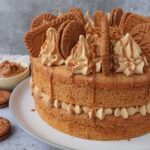
Vegan Biscoff Cake
Egg and dairy free two layer cake with Biscoff spread
Servings 12
Calories 802kcal
Ingredients
For the cake
- 150 ml Vegetable oil
- 450 ml Dairy free milk I used unsweetened almond milk
- 2 tsp Cider vinegar
- 2 tsp Vanilla extract
- 100 g Biscoff spread smooth
- 300 g Light brown soft sugar
- 500 g Self raising flour
- 2 tsp Baking powder
For the buttercream
- 200 g Dairy free butter I use Flora Plant unsalted
- 400 g Icing sugar
- 250 g Biscoff spread smooth
- 3-4 tbsp Dairy free milk I used unsweetened almond milk
For decoration
- 35 g Biscoff spread melted
- 6 Lotus Biscoff sandwich biscuits optional, use the regular biscuits if you prefer
- 6 Lotus Biscoff biscuits
- 1 Crushed Lotus Biscoff biscuit
Instructions
- Pre-heat your oven to 160C Fan/180C/350F/Gas Mark 4, and grease and line two 8" cake tins (that are at least 2" deep)
- In a mixing bowl, stir together the light brown soft sugar, self raising flour and baking powder
- In another mixing bowl or large jug, whisk together the vegetable oil, milk, vanilla extract, biscoff spread and vinegar. I find it's easier to add the biscoff first, then whisk the oil into it bit by bit, then add the other ingredients
- Make a well in the centre of the flour mixture, and pour in the oil and milk mixture, whisk them together gently with a hand whisk until smooth
- Divide the mixture between the tins, use scales for accuracy if you like
- Bake them for 35-40 minutes or until a skewer inserted in the middle comes out clean. Leave them to fully cool either in the tins or remove from the tin and place on cooling racks
- Make the buttercream by mixing together the dairy free spread and icing sugar, then add the biscoff spread and milk, and mix until smooth. You can do this by hand or for best results use an electric whisk
- If the cakes have domed on top, you can level them off with a cake leveller or a serrated knife
- Put one of the sponges on your plate or cake stand and pipe or spread some of the buttercream onto it
- Add the other sponge on top and pipe or spread the remaining buttercream on top
- Decorate with the melted Biscoff spread (microwave for 20 seconds to melt it) and the Biscoff biscuits. The biscuits will go soft after several hours in contact with the buttercream so add them later if you're not serving the cake straight away
- Leftovers will keep in an airtight container in a cool place for 2-3 days
Video
Notes
- I use oat or almond milk for the cake, but you can use any plant milk that you prefer.
- Smooth Biscoff spread is needed for this recipe. I don't recommend using the crunchy version of the spread.
- I really recommend using light brown soft sugar if you can, as it gives the cake a lovely caramel flavour. But if you can't get hold of it, you can use golden caster sugar or regular caster sugar (superfine sugar) instead.
- You do need to add the vinegar to this recipe to get a good rise - it reacts with the baking powder to create air bubbles. Cider vinegar is the best vinegar to use, but white vinegar would be a suitable replacement. Balsamic or malt vinegar (the kind you put on your chips) will not work. And don't worry - you can't taste the vinegar!
- I've found that the best dairy free butter for vegan buttercream is Flora Plant. Stork Baking Block is also very good. Using a block dairy free butter is much better for the buttercream. A margarine or spread style dairy free butter will make the buttercream too loose.
- You can use a different type of oil besides vegetable oil. I'd recommend one that doesn't have a strong flavour, canola and sunflower oil would both work well.
- Although I provide cup measurements, I highly recommend weighing your ingredients out using digital kitchen scales. It is the most accurate way to measure ingredients and will ensure the best results. Digital scales are very low cost and can be purchased for around £12 ($16.50) .
- For teaspoon (tsp) and tablespoon (tbsp) measurements, please use measuring spoons and not the type of spoons you eat with. Again this will ensure accuracy and provide the best results.
Nutrition
Calories: 802kcal | Carbohydrates: 106g | Protein: 7g | Fat: 40g | Saturated Fat: 16g | Cholesterol: 1mg | Sodium: 238mg | Potassium: 78mg | Fiber: 1g | Sugar: 68g | Calcium: 113mg | Iron: 1mg
