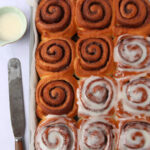
Cinnamon Rolls
Fluffly bread rolls with sweet cinnamon filling and a divine cream cheese frosting
Servings 12
Calories 381kcal
Ingredients
For the dough
- 550 g Strong white bread flour or you can use plain flour, the bread may rise less
- 1 Sachet Fast Action yeast (7g)
- 285 ml Semi skimmed milk or whole milk
- 4 tbsp Caster sugar
- 1 Egg large
- 75 g Butter unsalted
- ¼ tsp Salt
- 1 tsp Vanilla extract optional
For the cinnamon sugar filling
- 30 g Butter unsalted, melted
- 150 g Light brown soft sugar
- 3 tsp Cinnamon
For the cream cheese frosting
- 75 g Full fat cream cheese
- 150 g Icing sugar
- 2 tbsp Semi skimmed milk
Instructions
- Put the flour, fast action yeast, salt and sugar in a large bowl. Make sure that the salt and the yeast do not directly touch each other. Stir together so everything is well combined
- In a pan on a low heat, warm up the milk and butter until the butter melts, then add the vanilla extract. Let the mixture cool for 5-10 minutes or until lukewarm, then whisk the egg into it
- Pour the milk mixture into the flour mixture and bring everything together into a sticky dough. You can do this using a stand mixer, with it running on a low speed
- Knead the dough for 8-10 minutes either by hand on a very lightly floured surface or in an electric mixer with the dough hook attachment
- Place the kneaded dough in a large bowl that is lightly brushed with vegetable or olive oil, then cover with cling film or a clean tea towel, and leave in a warm place to rise for 1 hour or until doubled in size
- Make the cinnamon sugar filling by mixing the light brown sugar with the cinnamon
- Roll out the risen dough into a rectangle measuring roughly 35 x 30cm (14 x 12").
- Brush the melted butter all over it, then sprinkle the cinnamon sugar all over the top
- Roll the dough into a sausage shape, starting from the longest side, use a sharp knife to trim the ends then cut it into equal pieces. You can mark out the pieces before you cut with a ruler, you want them about 1 inch thick
- Place the cut rolls into a lined traybake tin (I used a 12" x 9" one), cover them loosely with cling film or a clean tea towel and leave them to rise for 1 hour
- Pre-heat your oven to 180C Fan/350F/Gas Mark 4
- Bake the rolls for 20-25 minutes, until golden brown
- After they have cooled, mix together the cream cheese, icing sugar and milk, and drizzle it over the buns
- Serve immediately, store leftovers in an airtight container in a cool place, or in the fridge if they have the frosting on, for 2-4 days. The buns can be frozen for up to 3 months
Video
Notes
- Strong bread flour is the best option for bread as it is high in protein which assists in the forming of gluten - a protein that creates the rise in bread, as well as creating the lovely bread texture that we all know and love. You can also make this recipe with regular plain flour, the bread may just rise a little less.
- You can use either semi-skimmed or whole milk for this recipe.
- Make sure the warmed milk and butter mixture cools to lukewarm or tepid before adding it to the flour mixture, this essentially means room temperature water which is around 18C to 23C. If it is added when it's above 30C this will most likely kill the yeast and your bread will not rise.
- If you are kneading the dough in your stand mixer, pop it into the bowl of your mixer and set it on a low speed with the dough hook attachment. Leave it to knead for 8-10 minutes, until the dough is smooth and supple, and comes away from the side of the bowl.
- For more information on bread making, including a guide on how to knead by hand and lots of tips and tricks, check out my White Bread Loaf recipe.
- Although I provide cup measurements, I highly recommend weighing your ingredients out using digital kitchen scales. It is the most accurate way to measure ingredients and will ensure the best results. Digital scales are very low cost and can be purchased for around £12 ($16.50).
- For teaspoon (tsp) and tablespoon (tbsp) measurements, please use measuring spoons and not the type of spoons you eat with. Again this will ensure accuracy and provide the best results.
Nutrition
Calories: 381kcal | Carbohydrates: 64g | Protein: 7g | Fat: 11g | Saturated Fat: 6g | Cholesterol: 41mg | Sodium: 153mg | Potassium: 113mg | Fiber: 1g | Sugar: 30g | Vitamin A: 347IU | Calcium: 62mg | Iron: 1mg
